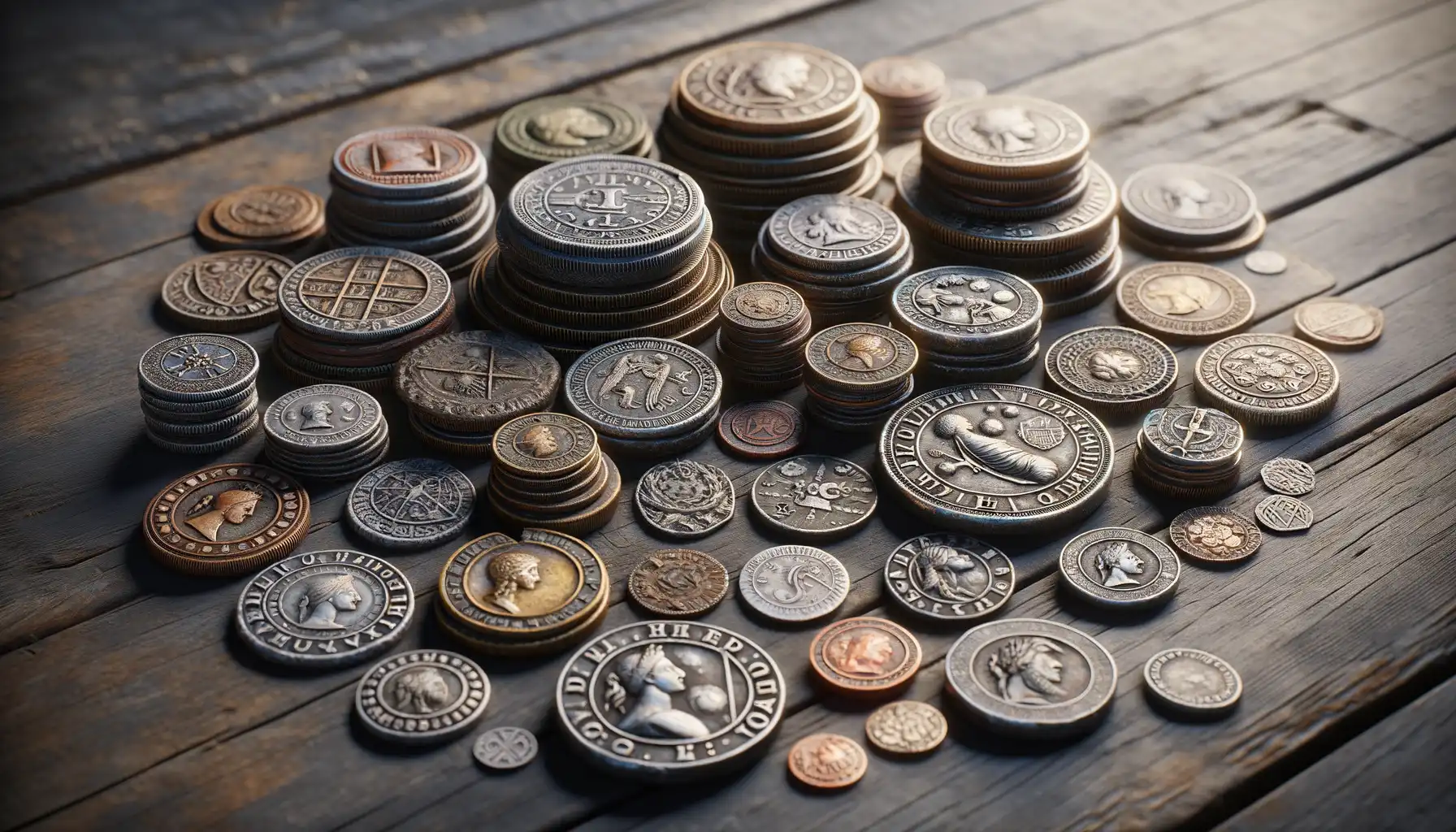
The 1984 dime appears to be a routine object of monetary circulation.
Under certain conditions, this routine nature becomes a subject of market negotiations.
The nominal 1984 dime value remains unchanged, yet the collector value demonstrates a significant spread depending on the strike quality.

The market does not always agree with the initial appraisal, giving preference to specimens featuring exceptional relief detailing.
In 1984, the United States Mint ensured the mass production of ten-cent coins to satisfy the needs of the commercial sector.
Production was carried out at three primary facilities using standard copper-nickel planchets.
This period is characterized by a high degree of wear on working dies, directly impacting the quality of most issued coins.
| Mint Facility | Mint Mark | Mintage | Issue Type |
| Philadelphia | P | 673,535,000 | Business Strike |
| Denver | D | 887,838,458 | Business Strike |
| San Francisco | S | 3,065,110 | Collector (Proof) |
Total emission exceeded 1.5 billion units, excluding physical scarcity for coins of average preservation.
Composition and Dimensions
- Outer Layers: Alloy of 75% copper and 25% nickel
- Core: 100% pure copper
- Total Mass: 2.27 grams
- Diameter: 17.9 millimeters
- Thickness: 1.35 millimeters
The thickness of the cladding layer constitutes a negligible part of the total volume, leaving the copper visible on the coin’s edge.
Value Hierarchy Based on Condition
The market value of a 1984 dime is tied to the Sheldon scale, where the highest points are awarded for an absence of defects.
For coins from circulation, the price rarely exceeds face value, considering the massive volumes of surviving currency.
Investment interest manifests starting from the MS67 grade, which is rare for this specific year.
| Grade | 1984-P Price ($) | 1984-D Price ($) | 1984-S Price ($) |
| MS65 / PR69 | $3 | $3 | $5 |
| MS66 / PR70 | $12 | $15 | $45 |
| MS67 | $45 | $60 | — |
| MS68 | $450 | $650 | — |
These figures reflect average values recorded from trading results over the last 24 months.
The Full Bands (FB) Phenomenon
The most critical criterion for evaluating the Roosevelt dime’s reverse is the detailing of the horizontal bands on the torch.
The Full Bands (FB) designation is assigned to coins having completely separated and clearly visible lines.
A lack of clarity in this area indicates a weak die strike or excessive contamination during the process.
| Issue | Price without FB | Price with FB | Difference |
| 1984-P MS67 | $45 | $285 | 533% |
| 1984-D MS67 | $60 | $350 | 483% |
Possessing FB status moves the coin into the category of scarce assets, reducing supply by dozens of times.
Auction Records of Recent Decades
Public sales statistics confirm the market’s readiness to pay a premium for exceptional characteristics.
In 2018, at a Heritage Auctions event, a 1984-P specimen in MS67FB grade was realized for $900.
For Denver coins, the record was fixed in 2022 at $1,320 for the MS68FB grade.
Collector specimens of Proof quality in PR70 Deep Cameo condition trade steadily in the range of $40 to $65.
Observed statistics indicate a shortage of 1984 coins without contact marks on the Roosevelt portrait.
Annual Price Change Dynamics
Analyzing market data for the period from 2014 to 2024 reveals specific patterns in capital movement.
The value of ordinary MS65 grades remains static, showing no growth over the decade.
Higher grades (MS67 and above) demonstrate an annual increase at the level of 4-6%.
In 2020, a surge of interest in certified 1984 coins was recorded, leading to a temporary price increase of 15%.
By 2023, prices corrected, returning to the long-term trend of gradual growth due to the reduction in the supply of unopened bank rolls.
Typical Production Defects of 1984
The minting process in the early 1980s was accompanied by several recurring technical issues.
When studying a lot, experts pay attention to signs of wear on the working surfaces of the equipment.
Common anomalies include:
- Weak strikes on the central letters of the word LIBERTY
- Die Clashes visible on the coin’s fields
- Microscopic Die Cracks
- Off-center strikes
Serious errors, such as a Double Die, are practically not recorded in significant quantities for the 1984 issue.
Philadelphia and Denver Issues
Despite similar mintages, coins from Denver (D) are traditionally valued higher in top-tier preservation categories.
This is due to grading report statistics showing fewer MS68 certificates issued for the Denver branch.
Philadelphia (P) coins are more frequently encountered with cladding defects appearing as dark spots.
The market reacts to this difference by establishing a 20-30% premium on Denver dimes given an identical grade.
Identifying Valuable Specimens
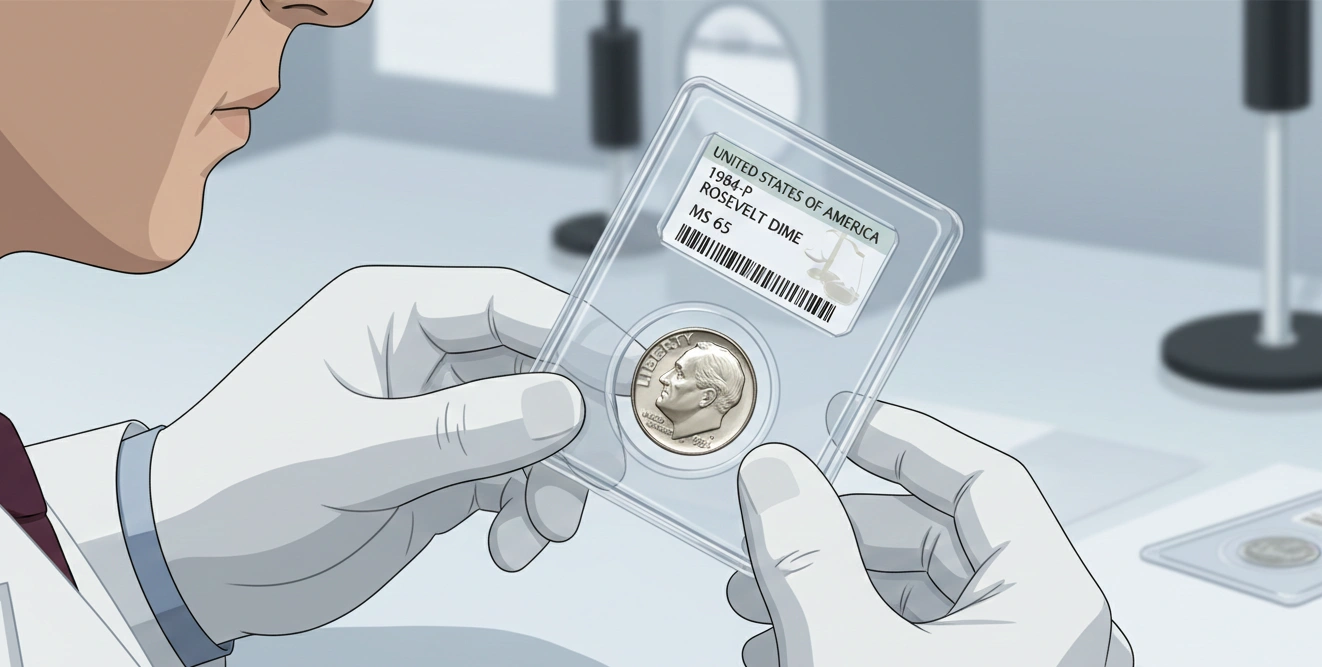
The process of searching for an investment-grade coin requires the use of specialized equipment.
- Verifying the year of issue and the mint mark under the portrait
- Using a microscope to study the integrity of the bands on the reverse torch
- Determining the presence of original mint luster without signs of cleaning
- Weighing the coin to confirm compliance with the 2.27-gram standard
- Evaluating the fields for an absence of “bag marks”
- Checking the rim condition for damage sustained during transport
Coins found in general circulation, in 99% of cases, have damage preventing them from claiming a grade higher than MS63.
Population Report
Registries of leading certification services (PCGS and NGC) serve as indicators of actual rarity.
For 1984-P in MS67FB grade, fewer than 200 specimens are registered.
The number of 1984-D coins in MS67FB grade totals approximately 150 units.
For the MS68FB condition, figures drop to isolated cases, making each such find a market event.
High population density in low grades confirms the mass nature of the issue and the lack of value for most existing coins.
Evaluation Methodology and Data Sources
Price indicators are formed based on aggregated data from public sales.
Only confirmed lots with high-resolution photographs are taken into account.
Archives from the following auction houses are utilized:
- Heritage Auctions
- GreatCollections
- Stack’s Bowers Galleries
- eBay (certified lots only)
Statistical errors are minimized by excluding transactions between related parties.
Mintage data is confirmed by annual reports from the US Treasury for the 1984 fiscal year.
Regular monitoring of registries allows for timely adjustments to market forecasts and price guides.